






Official information checked on 13 November 2026. This article provides general information, not individual tax advice.
When buying a home battery in the Netherlands, you may see offers referring to a subsidy or VAT recovery. Check exactly which scheme is being discussed and which conditions apply.
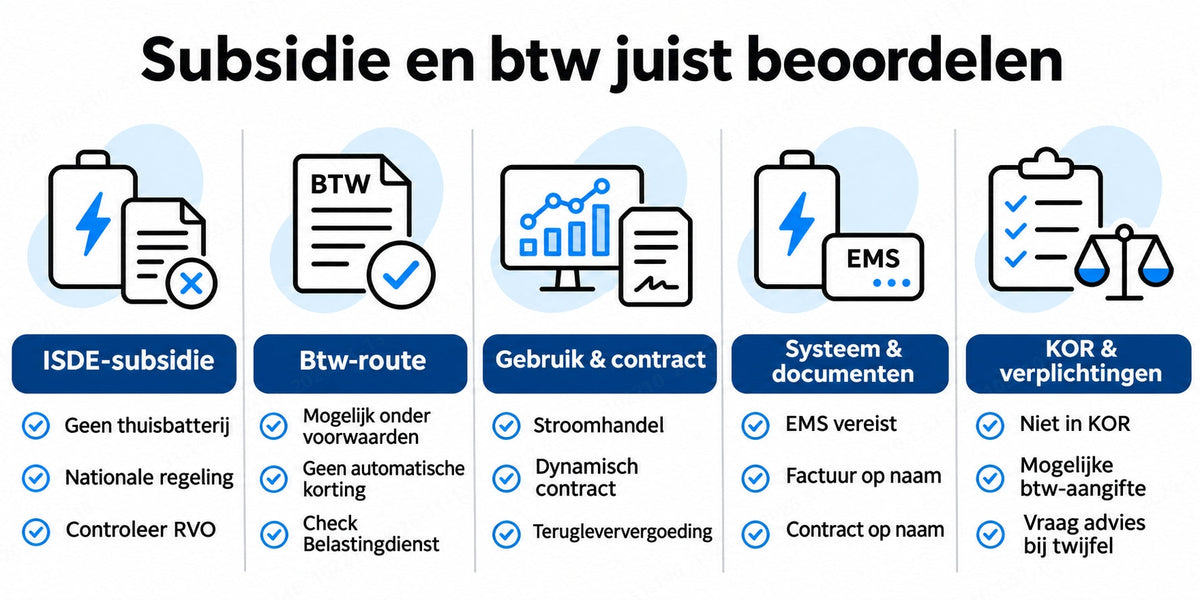
Home batteries are not eligible for the national ISDE subsidy. Recovering VAT may be possible under conditions when the battery is used to trade electricity. This can also create tax filing and payment obligations.
The following checklist helps you discuss those implications before buying.
At a glance
- ISDE: home batteries are not eligible for this national subsidy.
- VAT recovery: may be possible for electricity trading if all Tax Administration conditions are met.
- Private use only: using a battery solely for private purposes does not make you a VAT entrepreneur for that battery.
- Administration: consider VAT returns, VAT on export compensation and possible VAT on private use.
Consult the current RVO information about ISDE and the Dutch Tax Administration guidance on home batteries and VAT.
How do subsidies and VAT recovery differ?
A subsidy is financial support under a specific scheme. Eligibility depends on that scheme’s conditions. ISDE supports several sustainable-energy and efficiency measures, but not home batteries.
VAT recovery depends on your tax position and how the battery is used. Electricity trading can make you a VAT entrepreneur under the applicable conditions. This may allow purchase and installation VAT to be deducted, while creating other obligations.
An offer that simply says “get 21% back” therefore leaves out important information. Ask about eligibility, administration and the consequences of private use.
Which conditions should you check?
The Dutch Tax Administration lists conditions including:
- You use the battery to buy and sell electricity through your energy supplier, which pays you for exported electricity.
- The battery has an energy management system, or EMS, for electricity trading.
- You have a dynamic energy contract for that trading.
- The battery purchase invoice and energy contract are in your name.
- You are not participating in the small-business scheme, the KOR, when the battery is purchased and installed.
VAT cannot be recovered if the battery is used only privately, the supplier does not pay for exported electricity or the supplier does not allow export. See the Tax Administration’s complete conditions and examples.
Is an EMS or a dynamic contract enough?
No. An EMS and a dynamic contract are parts of the eligibility criteria. Actual electricity trading, export compensation, invoice ownership and KOR status also matter.
Do not rely on a product description alone. Have your particular combination of battery, settings and energy contract assessed. This article does not confirm the individual tax eligibility of any product or household.
What if you mainly store your own solar electricity?
If your goal is to use daytime solar generation in the evening, do not automatically include VAT recovery in the purchase calculation.
Discuss the intended use with your adviser. Consider what the system will actually do, rather than only the features it supports. The ability to export electricity does not, by itself, establish that your use meets every tax condition.
Check KOR status before buying
The KOR is a VAT exemption for small entrepreneurs. Participants cannot deduct VAT.
The Tax Administration states that withdrawal can take effect on the first day of a calendar quarter. Submit the withdrawal at least four weeks before that date. The invoice date and timing of purchase and installation also matter.
Late withdrawal can limit the deduction. Do not assume it can easily be corrected afterwards. Obtain advice before ordering, particularly if you already have solar panels, previously reclaimed VAT or are taking over a partner’s energy contract.
Once withdrawal takes effect, VAT obligations may arise on export compensation and private use.
Consider the obligations after purchase
Look beyond the amount you might reclaim at the time of purchase. The Tax Administration also describes obligations concerning returns and private use.
Consider:
- who will maintain the records and prepare returns;
- which records the EMS and energy bills provide;
- the potential cost of professional advice;
- how changes in the contract or battery use will be handled;
- what happens if you later join the KOR.
Keep invoices, contracts and supporting records. Also calculate the purchase case without VAT recovery, so an expected tax benefit is not the only reason for buying.
Treat subsidy offers carefully
RVO has warned about phishing emails promoting a supposed home battery subsidy. Always check unexpected offers through the official website.
- Enter the RVO or Tax Administration website address yourself.
- Ask for the exact scheme name and conditions.
- Be cautious about payment requests in unsolicited messages.
- Never share DigiD or banking login details with a seller.
- Save the official information used to make your decision.
A checklist before ordering
1. Define your goal. Do you want to increase solar self-consumption, trade electricity or do both?
2. Check the energy contract. Ask your supplier to confirm dynamic tariffs, export permission and compensation in writing.
3. Check the names on the documents. Review who holds the energy contract and whose name will appear on the invoice.
4. Check KOR status. Discuss existing VAT registrations and any steps needed before purchase.
5. Calculate the full implications. Include administration, advice fees and any VAT that may become payable.
6. Keep supporting records. Retain invoices, contract terms, EMS documentation and advice received.
7. Resolve uncertainty before buying. Seek advice before placing the order or having the invoice issued.
Frequently asked questions
Is there an ISDE subsidy for a home battery in 2026?
No. Home batteries are not covered by the national ISDE subsidy. Check any other proposed scheme separately with the authority offering it.
Can everyone recover the VAT on a home battery?
No. This depends on electricity-trading use and the Tax Administration’s conditions. It is not an automatic purchase discount.
Does a dynamic energy contract automatically establish eligibility?
No. The EMS, export compensation, invoice ownership, KOR status and actual use are also relevant.
Can I recover VAT if I only store my own solar power?
Using the battery solely privately does not make you a VAT entrepreneur for that battery. Do not assume VAT recovery is available.
Your next step
Read the official conditions for home batteries and VAT. Then discuss your contract, intended use and tax position with a tax adviser before ordering.
Sources

Leave a comment
This site is protected by hCaptcha and the hCaptcha Privacy Policy and Terms of Service apply.